
Vector Labs代理,歡迎訪問Vector Labs官網(wǎng)或者咨詢我們獲取相關(guān)Vector Labs產(chǎn)品信息以及報(bào)價(jià)。
Vector Labs 公司是世界著名的生物學(xué)檢測試劑公司,七十年代其在全球首推的生物素-親和素系統(tǒng)引領(lǐng)了生物學(xué)檢測方法的重大革命,該系統(tǒng)被普遍視為目前最靈敏、最可靠與最有效的染色系統(tǒng),并被廣泛應(yīng)用于免疫組織化學(xué)、免疫電鏡、原位雜交與凝集素化學(xué)中。該系統(tǒng)仍在不斷地發(fā)展,以滿足廣大研究人員的各種不同要求。Vector 公司還是世界上凝集素產(chǎn)品的主要供應(yīng)商,并提供大量的新產(chǎn)品,如酶底物、神經(jīng)元示蹤劑及蛋白質(zhì)、糖類與核酸的標(biāo)記、分離與檢測試劑。
Vector? TrueVIEW? Autofluorescence Quenching Kit
Description
The TrueVIEW Autofluorescence Quenching Kit provides a novel way?to diminish unwanted autofluorescence from non-lipofuscin sources and dramatically improve signal-to-noise ratio. TrueVIEW removes unwanted autofluorescence in tissue sections due to aldehyde fixation, the presence of red blood cells, and structural elements such as collagen and elastin.?The quenching action of the kit reagents provides a clear, unambiguous, “true view” localization of the target antigen.
This kit offers you:
- Effectivity with problematic tissues such as kidney and spleen
- An easy-to-use, one-step method
- Compatibility with a wide selection of fluorophores
- Compatibility with standard epifluorescence and confocal laser microscopes
- Availability with DAPI counterstain and without.
?
One kit is sufficient to treat approximately 100 to 150 tissue sections.?
Specifications
| Unit Size | 15 ml |
|---|---|
| Applications | Immunofluorescence, In situ hybridization |
| Blocking Action | Autofluorescence |
| Format | Concentrate |
Kit Components
What’s in the box?
- TrueVIEW Reagent A, 5 ml
- TrueVIEW Reagent B, 5 ml
- TrueVIEW Reagent C, 5 ml
- VECTASHIELD? Vibrance™ Antifade Mounting Medium, 2 ml
Documents
- Safety Data Sheet
- TrueVIEW? Application Note
- User Guide
- Download CoA
- Datasheet
Product FAQs
Why is the TrueVIEW™ Autofluorescence Quenching reagent applied after completion of the IF assay and not at the start of the procedure?
Do you have any published references describing the use of TrueVIEW Autofluorescence Quenching Kit?
Yes, there are a number of published references describing the use of TrueVIEW Autofluorescence Quenching Kit in the scientific literature. Please refer to a partial list of these publications in the Technical Information section of the product detail page for SP-8400.
Is TrueVIEW effective against lipofuscin derived autofluorescence?
How long can I store the TrueVIEW working solution?
My tissue sections turned blue when I applied TrueVIEW. Is this supposed to happen?
What mounting media can I use with TrueVIEW?
For the wash step after applying the TrueVIEW quenching reagent, can I use buffers other than PBS or detergents?
No, we have found that the TrueVIEW reagent lifts off the tissue using TBS or HEPES buffer. Detergents are incompatible.
Related Products
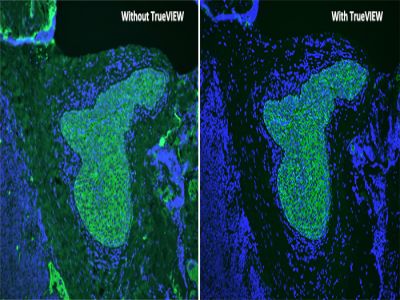
Vector? TrueVIEW? Autofluorescence Quenching Kit with DAPI Catalog #: SP-8500-15
VECTASHIELD? Vibrance™ Antifade Mounting Medium Catalog #: H-1700
VECTASHIELD? HardSet™ Antifade Mounting Medium Catalog #: H-1400-10
Carbo-Free Blocking Solution (10x Concentrate) Catalog #: SP-5040-125
Citations
 Powered by Bioz See more details on Bioz
Technical Information
Tissue autofluorescence often occurs with aldehyde fixation or from inherent native tissue components (collagen, elastin, and red blood cells). The extent and intensity of autofluorescence background frequently makes it difficult or impossible to distinguish specific signals in immunofluorescence applications.
Most methods for reduction of tissue autofluorescence act primarily on lipofuscin granules, and are not broadly effective against the most common sources of autofluorescence targeted by TrueVIEW Quencher.
Current methods for reducing autofluorescence primarily include “home brew” concoctions such as sodium borohydride and other ink-based products. These methods are essentially ineffective against aldehyde induced autofluorescence. In contrast, TrueVIEW reagent binds to hydrophilic compounds and effectively quenches endogenous autofluorescence.

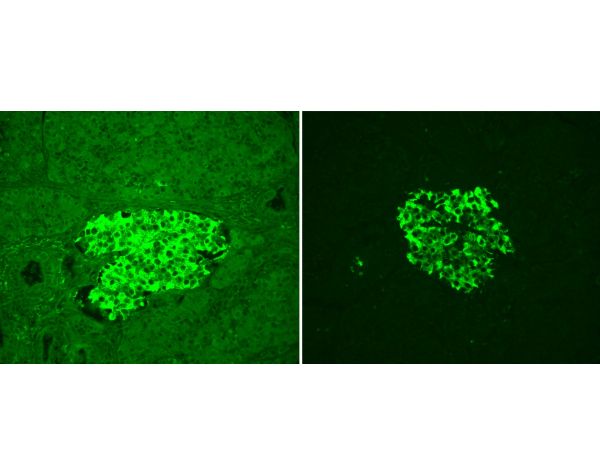
Left Image: No TrueVIEW Quencher treatment - 20x objective, red channel exposed 200ms, green channel 200ms. Note presence of interfering autofluorescence.
Right Image: Cells treated with TrueVIEW Autofluorescence Quencher - 20x objective, red channel exposed 200ms, green channel exposed 800ms. Note absence of autofluorescence.

Left Image: No TrueVIEW Quencher used, 20x objective, red channel exposed 600ms, green channel 600ms.
Right Image: TrueVIEW Quencher used with 20x objective, red channel exposed 600ms, green channel exposed 600ms.
TrueVIEW is very easy to apply: Following completion of the IF staining procedure:

Mode of Action

Signal to Noise Optimization
The primary antibody and detection reagents should be optimized (titered) in conjunction with Vector TrueVIEW Quenching Kit to achieve maximum signal to noise.

Optimization of Exposure
Increasing exposure times may be necessary to achieve optimal image acquisition for TrueVIEW Quencher treated slides.

Comparison Between Vector TrueVIEW Reagent and Other Autofluorescence Reducing Agents
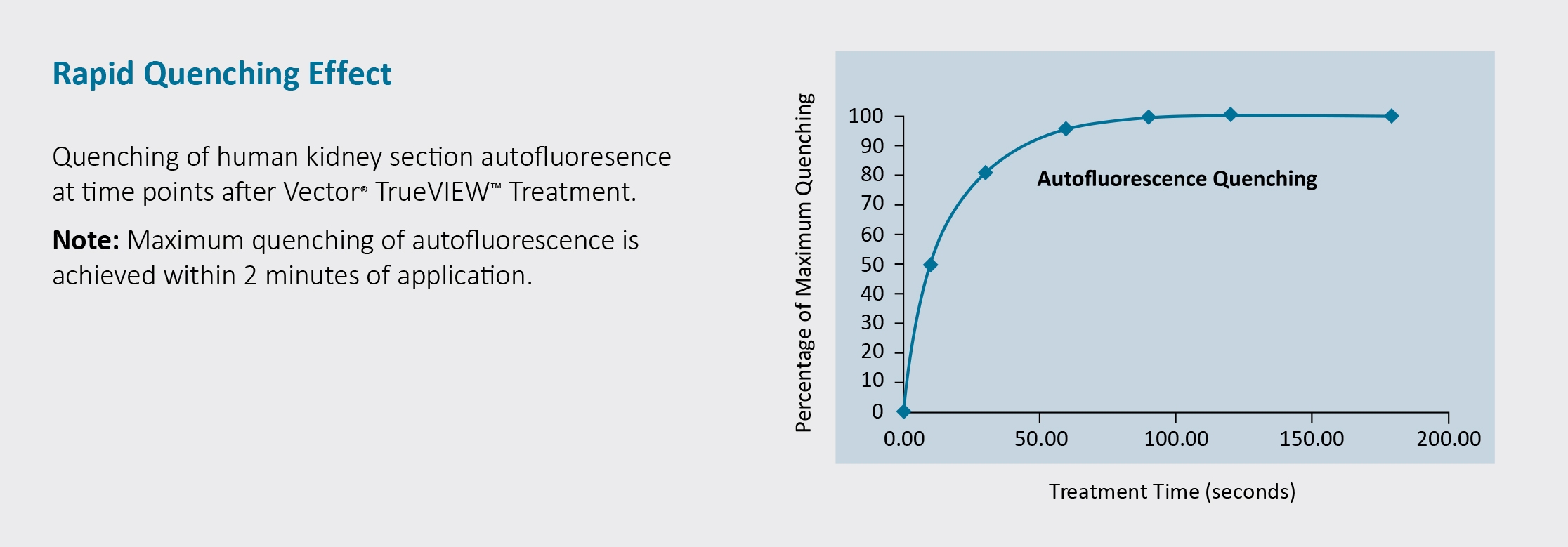
We compared the effectiveness of Vector TrueVIEW quenching action in parallel with other commercially available autofluorescence reducing products and "home brew" reagents, on serial sections of formalin-fixed, paraffin-embedded human pancreas visualized using a standard fluorescein (green) filter. No specific immunofluorescence staining was conducted. The images below highlight our results. All images were acquired under identical conditions (including microscope objective and exposure times).

Customer Testimonials

Publications:
- McTiernan, C. et al. 2020. LiQD Cornea: Pro-regeneration collagen mimetics as patches and alternatives to corneal transplantation. Science Advances. Vol. 6, no. 25.
- Hou, Y. et al. 2020. SARS-CoV-2 Reverse Genetics Reveals a Variable Infection Gradient in the Respiratory Tract. Cell. 182, 1–18
- Takenaga, K. et al. Cancer cell-derived interleukin-33 decoy receptor sST2 enhances orthotopic tumor growth in a murine pancreatic cancer model. PLoS ONE. 15(4): e0232230.
- Fiock K. et al. 2020. Increased Tau Expression Correlates with Neuronal Maturation in the Developing Human Cerebral Cortex. eNeuro. 7(3): ENEURO.0058-20.2020.
- Murata, A. and Hayashi, S. 2020. CD4+ Resident Memory T Cells Mediate Long-Term Local Skin Immune Memory of Contact Hypersensitivity in BALB/c Mice. Front Immunol. 11: 775.
- Wilson, M. et al. 2020. Lgr5-positive endothelial progenitor cells occupy a tumor and injury prone niche in the kidney vasa recta. Stem Cell Research. Volume 46, July 2020, 101849.
- Milstone, Z. et al. 2020. Histone deacetylases 1 and 2 silence cryptic transcription to promote mitochondrial function during cardiogenesis. Science Advances. Vol. 6, no. 15, eaax5150
- Duler, L. et al. 2020. Identification of Neutrophil Extracellular Traps in Paraffin-Embedded Feline Arterial Thrombi using Immunofluorescence Microscopy. Journal of Visualized Experiments. (157), e60834, doi:10.3791/60834
- Takahashi, K. et al. 2020. Eosinophils are the main cellular targets for oral gene delivery using Lactic acid bacteria. Vaccine. 38(17):3330-3338
- Parsons Aubone, A. et al. 2020. Presence of Clock genes in equine full-term placenta. Journal of Animal Science.
- Williams, J. et al. 2020. Mylk3 null C57BL/6N mice develop cardiomyopathy, whereas Nnt null C57BL/6J mice do not. Life Sci Alliance. 3(4): e201900593
- Plant, T. et al. 2020. Semaphorin 3F signaling actively retains neutrophils at sites of inflammation. The Journal of Clinical Investigation.
- de Barros Mucci, D. et al. 2020. Impact of maternal obesity on placental transcriptome and morphology associated with fetal growth restriction in mice. International Journal of Obesity. 44, 1087-1096
- Cui, H. et al. 2020. Monocyte-derived alveolar macrophage Apolipoprotein E participates in pulmonary fibrosis resolution. JCI Insight.
- Kimura, Y. et al. 2020. Soluble Uric Acid Promotes Atherosclerosis via AMPK (AMP-Activated Protein Kinase)-Mediated Inflammation. Arteriosclerosis, Thrombosis, and Vascular Biology. 40:570–582.
- Blanco, S. et al. 2020. Hyaluronate Nanoparticles as a Delivery System to Carry Neuroglobin to the Brain after Stroke. Pharmaceutics
- Fallet, B. et al. 2020. Chronic Viral Infection Promotes Efficient Germinal Center B Cell Responses. Cell Reports. 30, 1013–1026.
- Kerby, A. et al. 2020. Placental Morphology and Cellular Characteristics in Stillbirths in Women With Diabetes and Unexplained Stillbirths. Archives of Pathology & Laboratory Medicine.
- Imamura, T. et al. 2020. Insulin deficiency promotes formation of toxic amyloid-β42 conformer co-aggregating with hyper-phosphorylated tau oligomer in an Alzheimer's disease model. Neurobiology of Disease. 137:1047392.
- B?rnthaler, T. et al. 2020. Inhibiting eicosanoid degradation exertsantifibrotic effects in a pulmonary fibrosismouse model and human tissue. Journal of Allergy and Clinical Immunology. Volume 145, Issue 3, Pages 818-833.e11
- Vinton, C.L. et al. 2019. Simian Immunodeficiency Virus Infection of Rhesus Macaques Results in Delayed Zika Virus Clearance. mBio
- Ushioda, W. et al. 2019. Neuropathology in Neonatal Mice After Experimental Coxsackievirus B2 Infection Using a Prototype Strain, Ohio-1. Journal of Neuropathology & Experimental Neurology. doi/10.1093/jnen/nlz124
- Oswald, D.M., Jones, M.B., Cobb, B.A. 2019. Modulation of hepatocyte sialylation drives spontaneous fatty liver disease and inflammation. Glycobiology. doi/10.1093/glycob/cwz096
- Ibrahim, M. et al. 2019. Once Daily Pregabalin Eye Drops for Management of Glaucoma. ACS Nano. 13, 13728?13744.
- Bencze, J., et al. 2019. Neuropathological characterization of Lemur tyrosine kinase 2 (LMTK2) in Alzheimer’s disease and neocortical Lewy body disease. Scientific Reports
- Davies, S.P. et al. 2019. Hepatocytes Delete Regulatory T Cells by Enclysis, a CD4+ T Cell Engulfment Process. Cell Reports
- Liebers, J. et al. 2019. 3D image analysis reveals differences of CD30 positive cells and network formation in reactive and malignant human lymphoid tissue (classical Hodgkin Lymphoma). PLoS One
- Lecocq, Q. et al. 2019. Noninvasive Imaging of the Immune Checkpoint LAG-3 Using Nanobodies, from Development to Pre-Clinical Use. Biomolecules
- Motoike, S. et al. 2019. Clumps of Mesenchymal Stem Cell/Extracellular Matrix Complexes Generated with Xeno-Free Conditions Facilitate Bone Regeneration via Direct and Indirect Osteogenesis. International Journal of Molecular Sciences
- Wilson, M.R. et al. 2019. ARID1A and PI3-kinase pathway mutations in the endometrium drive epithelial transdifferentiation and collective invasion. Nature Communications
- Nagai-Okatani, C. et al. 2019. Wisteria floribunda agglutinin staining for the quantitative assessment of cardiac fibrogenic activity in a mouse model of dilated cardiomyopathy. Laboratory Investigation
- Sheller-Miller, S. et al. 2019. Cyclic-recombinase-reporter mouse model to determine exosome communication and function during pregnancy. American Journal of Obstetrics and Gynecology
- Abe, H. et al. 2019. Correlation between platelet thrombus formation on collagen-coated beads and platelet aggregation induced by ADP. Transfusion and Apheresis Science
-
Singh, B. et al. 2019. Tau is required for progressive synaptic and memory deficits in a transgenic mouse model of α-synucleinopathy. Acta Neuropathologica
- Chafe, S.C. et al. 2019. Targeting hypoxia-induced carbonic anhydrase IX enhances immune-checkpoint blockade locally and systemically. Cancer Immunol Res
- Rhodes, S. et al. 2019. Cdkn2a (Arf) loss drives NF1-associated atypical neurofibroma and malignant transformation. Human Molecular Genetics
- Su, X. et al. 2019. Imaging and Tracking Stem Cell Engraftment in Ischemic Hearts by Near-Infrared Fluorescent Protein (iRFP) Labeling. Methods in Molecular Biology
- Rodgers, H.M. et al. 2019. Dopamine D1 and D3 receptor modulators restore morphine analgesia and prevent opioid preference in a model of neuropathic pain. Neuroscience
- Yoon, J.H., Li, M., Basile, J.R., Lin, Y 2018. Computer-assisted analysis of immunohistological parameters in oral giant cell granulomas. Oral Diseases
- Nishimura, A. et al. 2018. Hypoxia-induced interaction of filamin with Drp1 causes mitochondrial hyperfission–associated myocardial senescence. Science Signaling
- Su Y, Hou Y, Wang Q. 2018. The enhanced replication of an S-intact PEDV during coinfection with an S1 NTD-del PEDV in piglets. Veterinary Microbiology
- Soontornniyomkij, V. et al. 2018. Association of antiretroviral therapy with brain aging changes among HIV-infected adults. AIDS
- Du, H. et al. 2018. A novel mouse model of hemangiopericytoma due to loss of Tsc2. Human Mol. Gen.
- Boucher, J.M. et al. 2018. Rab27a regulates human perivascular adipose progenitor cell differentiation. Cardiovasc Drugs Ther.